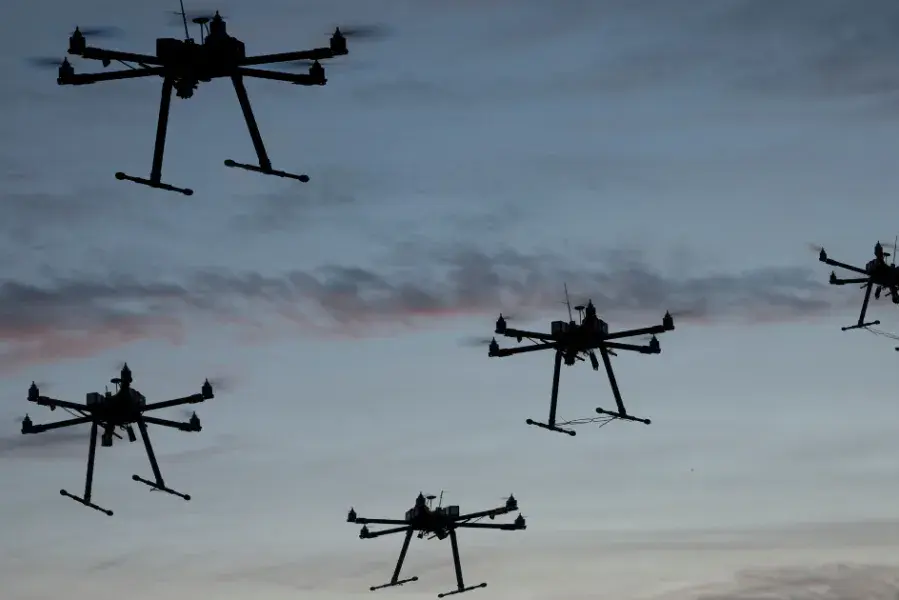

By: Conrad Crookston
For decades, the United States has enjoyed something far greater than air superiority: air dominance. Since World War II, no nation has matched America’s ability to control the skies, project power globally, and deploy aircraft with near impunity against technologically inferior adversaries. From the first Gulf War to counterterrorism operations across the Middle East, American airpower has served as the foundation of its military advantage.
Those days are ending.
A new threat has quietly but rapidly reshaped the modern battlespace. It is inexpensive, ubiquitous, highly adaptable, and available to anyone with an internet connection. The threat is not low observable aircraft, hypersonic missiles, or space-based weapons. It is something far smaller and far more disruptive.
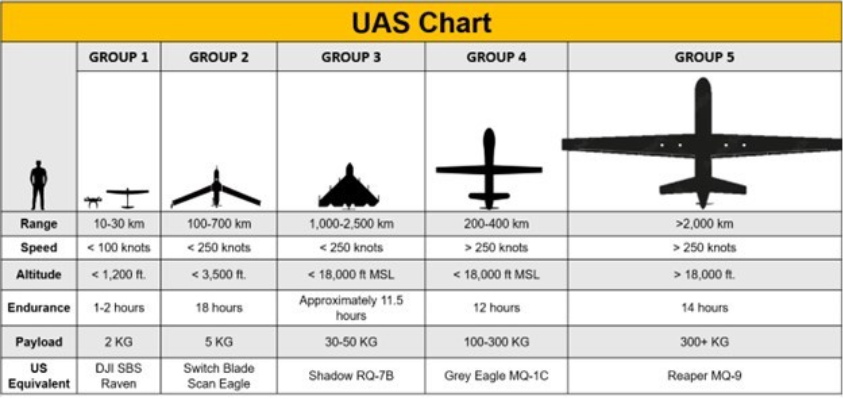
Photo from westpoint.com (May 14, 2024, https://www.defensetechacquisition.com/p/news-5-18-24)
The rise of these Group 1 (see chart, above), commercially available aircraft marks a seismic shift in military affairs, one the United States has been dangerously slow to acknowledge. The age of traditional air dominance is giving way to an era where quantity beats quality, and where $500 drones regularly defeat multimillion-dollar systems. The implications stretch far beyond any single battlefield, posing a challenge to U.S. strategy, doctrine, procurement, and assumptions that have gone unquestioned for nearly a century.
Modern drones are categorized into five groups based on size, capability, and operational range. Category Five drones, large, powerful, and long-endurance, have historically required state-level resources, advanced logistics, and trained operators. These were the domain of militaries, not individuals.
But technological progress, driven largely by commercial markets, has flipped this model. Advances in lithium batteries, miniaturized sensors, lightweight materials, stabilized cameras, and autonomous flight software have created an ecosystem where group 1 drones are no longer specialized tools…they are consumer electronics.
As a result, the barriers to entry for aerial capability have collapsed. Instead of purchasing a $30,000 military-grade system with extensive training requirements, a person can now buy a highly maneuverable, GPS-guided, camera-equipped drone for a few hundred dollars, all delivered to their doorstep within 48 hours.
The sky, once reserved for state militaries and powerful air forces, now belongs to everyone.
No conflict has demonstrated this transformation more starkly than the war in Ukraine. What began as a conventional land war quickly evolved into a drone-dominated battlespace where the cheapest systems deliver the deadliest results. Both sides deploy drones at a scale previously unimaginable, tens of thousands per month.
The results are unprecedented:
Class one drones now identify, track, and kill targets more reliably than traditional Intelligence, Surveillance and Reconnaissance (ISR) assets. First-person-view (FPV) kamikaze drones, many commercially available and easily modified to carry explosives or other payloads, have become precision-guided munitions costing less than a dinner out, operated remotely from miles away. Drones destroy tanks, artillery, vehicles, command posts, and troops daily. Most battlefield deaths are now attributed to drones, not traditional weapons.
Perhaps most importantly, Ukraine has shown that no traditional air force, no matter how advanced, can meaningfully dominate low-altitude airspace saturated with cheap drones.
The U.S. military, which has relied on high-tech fighters, standoff munitions, and advanced surveillance systems, is now confronted with a reality where those platforms are less relevant, not because they are insufficient, but because they were never designed for this fight.
Despite the clear warning signs, the United States has been slow to adapt. The reasons are many and familiar:
- Legacy procurement cycles designed for decades-long projects, not rapid innovation
- An acquisition culture that favors large, expensive platforms with institutional backing
- Resistance to abandoning existing systems that represent billions in sunk costs
- A belief that emerging threats can be mitigated by incremental upgrades to outdated technology
The result is a dangerous mismatch between the evolving threat landscape and America’s current capabilities, one compounded by unresolved ethical and philosophical challenges, as warfare becomes increasingly impersonal and accountability for killing becomes increasingly detached from those who carry it out.
While adversaries rapidly iterate on cheap, modular, expendable drones, the U.S. continues attempting to retrofit legacy systems to meet challenges they were never designed to confront. Efforts to develop counter-UAS solutions are underway, but they are slow, fragmented, and often rely on expensive, centralized systems that are easily overwhelmed by low-cost swarms.
What little progress has been made is not nearly enough.
The era in which air dominance meant possessing the most advanced fighters and bombers is over. The new competition is not over altitude or speed; it is over volume, resilience, and affordability.
Modern air dominance looks like this:
- Thousands of drones flooding the airspace
- Autonomous swarms coordinating without human intervention
- Inexpensive systems executing precision strikes
- AI-driven reconnaissance mapping the battlefield in real time
- Ubiquitous aerial surveillance rendering concealment nearly impossible
- Electrically powered aircraft launching from backpacks, not bases
This is not the future, this is now, and the U.S. is on the wrong side of the curve.
Ignoring this threat is not merely shortsighted, it is dangerous.
If adversaries continue advancing at the current pace, the U.S. risks losing more than its technological advantage; it risks losing its doctrinal foundation. American strategy is built on the assumption of aerial freedom of movement. Without it:
- Ground forces lose protection
- Naval vessels become more vulnerable
- Bases and logistics hubs are exposed
- Intelligence collection becomes fragmented
- Precision strikes become harder to guarantee
- The cost of war becomes dramatically higher as the U.S. is forced to defend and replace high end systems against low cost, attritable threats and, thus far, we have refused to shift gears to low-cost, replaceable drones.
Adversaries understand this and they are racing ahead.
Unless the United States rapidly adapts, the advantage it has relied on for generations may evaporate entirely.
The solution is not to marginally improve existing systems. It is to rethink airpower from the ground up, embracing the technologies, doctrines, and strategies that define drone-era warfare.
This requires:
- Massive investment in small drone production and rapid iteration
- Distributed, low-cost counter-UAS systems deployable at scale
- Integration of AI and autonomy across drone fleets
- A shift from platform-centric thinking to capability-centric thinking
- New training pipelines focused on drone swarms and electronic warfare
- Aggressive partnerships with commercial drone innovators
- Acceptance that expendable systems are now the backbone of airpower
The United States must stop trying to force legacy systems into a modern fight. Instead, it must build systems meant for the world as it is, a world where the skies belong to everyone.
Air dominance is no longer guaranteed by advanced jets and billion-dollar programs. It is determined by who can adapt the fastest, iterate the quickest, and deploy the most drones at the lowest cost.
The U.S. cannot afford to cling to outdated assumptions or legacy solutions. Every day spent debating the threat is a day adversaries spend refining it. The skies are changing, and with them, the nature of warfare itself.
The question is no longer whether drones will define battlespace.
The question is whether the United States will recognize this reality in time to remain dominant within it.